
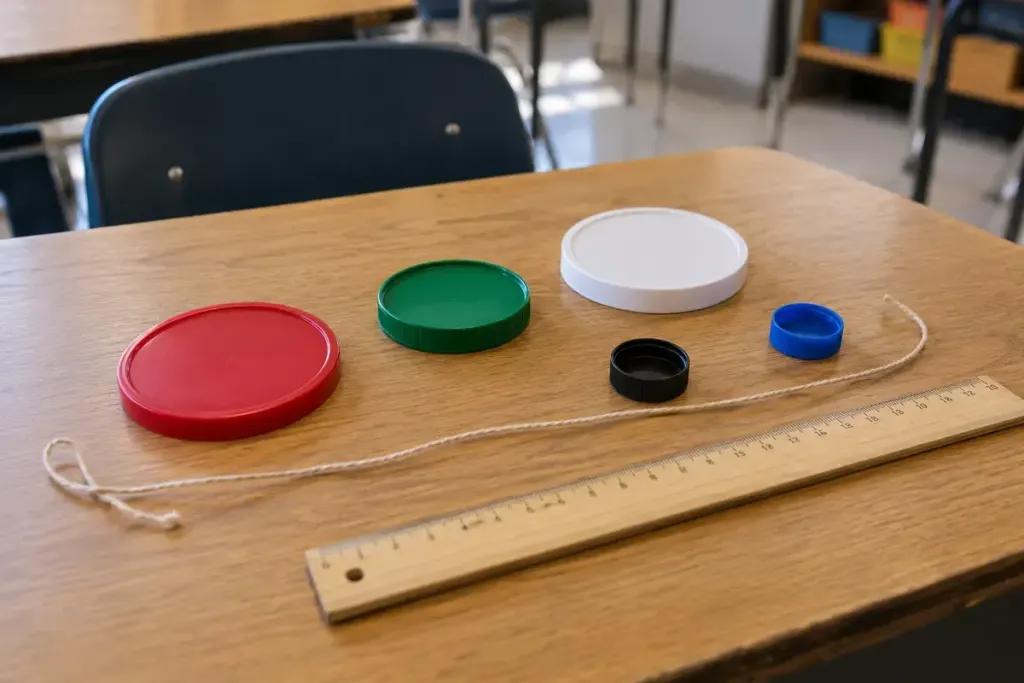
A jar lid and a bucket lid have very different distances around their edges. Yet dividing each circumference by its diameter gives approximately the same result. This relationship is a useful way to meet pi before memorising a formula.
For circles in ordinary plane geometry, pi is the constant ratio of circumference to diameter. The Australian Mathematical Sciences Institute’s circumference resource explains this relationship. The approximation 3.14 is convenient for some calculations; it is not the complete value of pi.
Try three lids before explaining the pattern
Choose rigid, circular objects of different sizes, a ruler and a piece of string that does not stretch easily. Avoid a rim that is bent or a container whose top is oval.
- Wrap the string once around a lid’s outside edge, mark the meeting point and measure that length.
- Measure the diameter across the centre, from one edge to the opposite edge.
- Use the same units for both measurements, then divide the circumference by the diameter.
- Repeat for the other lids and record each result without rounding too early.
Your results might be near 3.14 without matching it exactly. A loose string, a thick pencil mark or a measurement that misses the centre can all change the calculation. The activity estimates a mathematical relationship; it does not redefine pi for each lid.
Ask what happens when the circle doubles
Imagine enlarging a circular drawing so that every length becomes twice as large. Its diameter doubles, and the distance around it doubles too. Dividing one doubled length by the other leaves their ratio unchanged.
A helpful classroom question is: “Which measurement would you recheck if one lid gave a very different result?” It invites pupils to examine evidence instead of forcing the numbers to match the expected answer.
Keep the original measurements beside any corrected ones. That makes the reasoning visible and gives a useful discussion about precision. When the formula for circumference appears later, it then describes a relationship pupils have already investigated, rather than arriving as an unexplained rule to copy.