
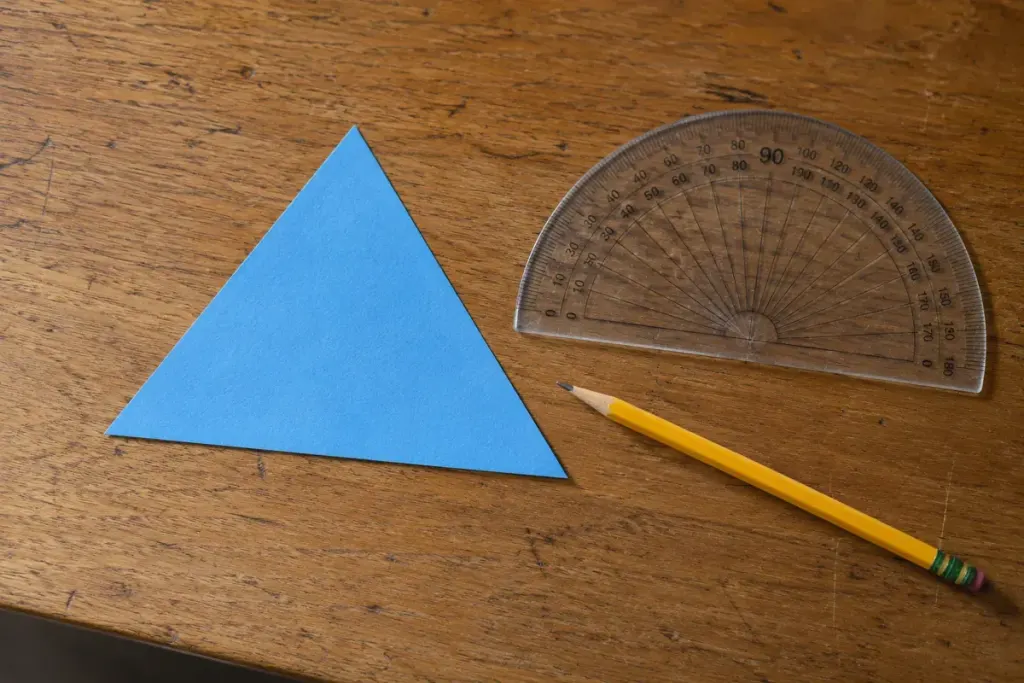
Cut the three corners from a paper triangle and place their points together. When the edges are arranged carefully, the corners form a straight angle. It is a satisfying classroom observation, but it also raises a better question: why should this work for triangles of different shapes?
For an ordinary triangle on a flat, Euclidean plane, the interior angles add to 180 degrees. Math Is Fun’s illustrated proof explains the result by drawing a line through one vertex parallel to the opposite side. The parallel lines allow the other two angles to be matched at the top, where the three angles together form a straight line.
Use the paper model as a starting point
Try a narrow triangle and a broad one. Mark the corners in different colours before cutting so the pieces cannot be confused. Use age-appropriate scissors with supervision, or prepare the pieces in advance.
Ask learners to describe what stays the same and what changes. The side lengths and individual angles vary, but the three corners still fit the same straight angle. Small gaps from rough cutting are measurement imperfections, not evidence that the mathematical result is approximate.
Move from seeing to explaining
Draw the parallel line and identify the equal angle pairs. Explain why parallelism matters; a line that merely looks nearly parallel on a sketch is not the premise of the proof. The argument, rather than the quality of the drawing, establishes the angle sum.
Then use the result in a fresh example. If two interior angles are 47 and 68 degrees, the third is 65 degrees because 180 − 47 − 68 = 65. These are invented classroom values. Check that the answer describes an interior angle, not an exterior angle beside the triangle.
Keep the setting clear: triangles drawn along curved surfaces can follow different geometry. The familiar 180-degree result belongs to the flat-plane model being used here.
Finishing with both the paper arrangement and the parallel-line explanation lets learners distinguish a convincing demonstration from the reason it works.