
A ribbon is one metre long. Write its length as 100 centimetres and the ribbon does not grow. The number changes because the unit becomes smaller, so more of those units are needed to describe the same distance.
Keep the object in view
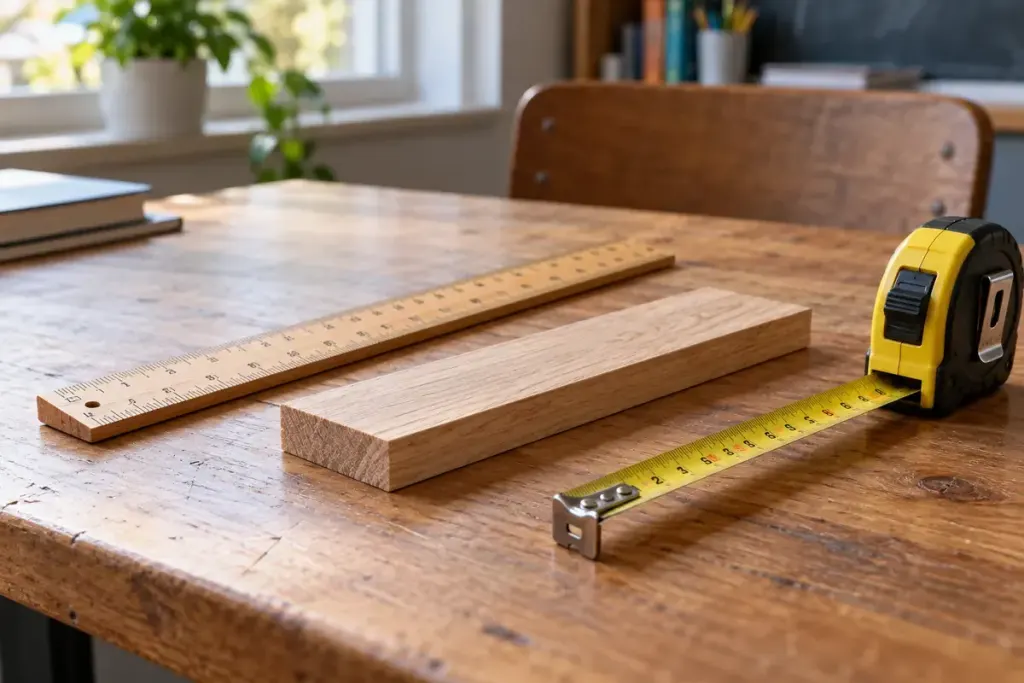
Use a metre rule or measuring tape and a strip of paper or ribbon. Mark a measured length, then describe it in both metres and centimetres. Let learners point to the same endpoints while saying both measurements.
One metre equals 100 centimetres. Therefore 1.5 metres equals 150 centimetres, and 50 centimetres equals 0.5 metres. These are exact unit conversions; the precision of a real measurement still depends on the tool and how it is used.
Ask for an explanation before a shortcut
Instead of beginning with “move the decimal point,” ask why the centimetre number is larger. A learner who can explain that centimetres are smaller units has a reason for the calculation and a way to catch an implausible answer.
Try this invented problem: a shelf is 80 centimetres wide, while a storage label lists a box as 0.9 metres wide. Convert one measurement so both use the same unit. The box is 90 centimetres wide, so it is wider than the shelf. This comparison concerns width only; other dimensions would still need checking.
- Write the unit beside every number.
- Estimate whether the converted number should increase or decrease.
- Use the same endpoints when measuring.
- Check that the problem compares the same dimension.
Then reverse the exercise. Give a measurement in centimetres and ask for metres, with a sketch showing the unchanged object. If a learner says the object became shorter, return to the physical strip rather than adding more calculation rules.
Finish with a sentence: “The length stayed the same; I changed the unit used to describe it.” That idea supports later work with mass, volume and other measurements without treating conversion as a mysterious movement of digits.