
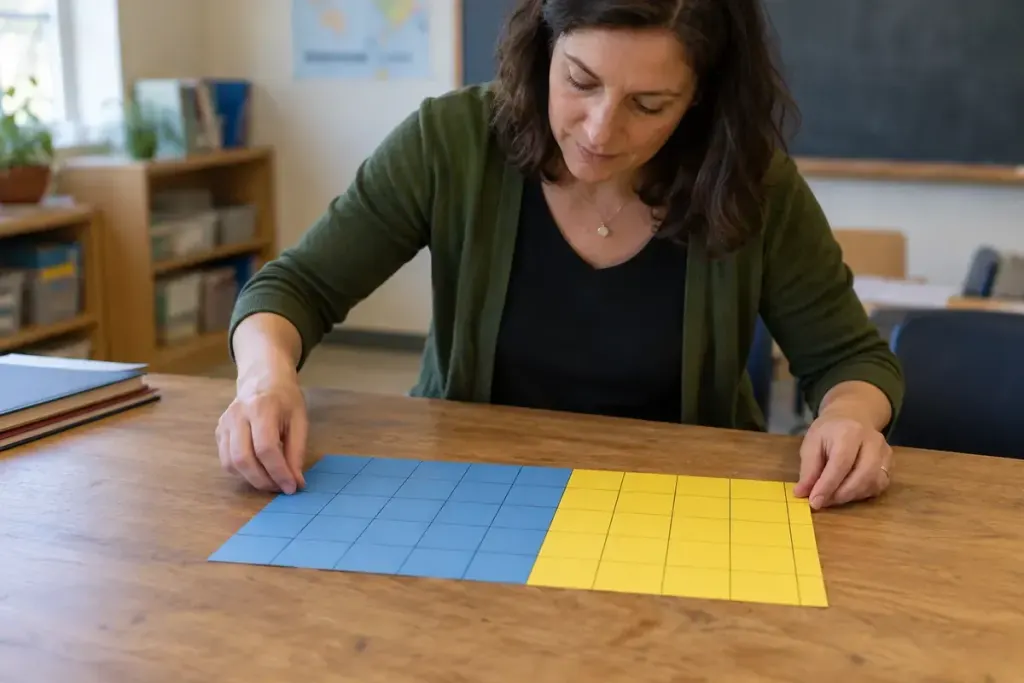
Multiplying a number by a sum can look like a rule to memorise: multiply each part, then add. A rectangle gives the rule a visible reason. Splitting its width creates two smaller rectangles whose areas still make up the original area.
Draw a rectangle five units high and thirteen units wide. Split the width into ten and three. The left area is five times ten, or fifty square units. The right area is five times three, or fifteen square units. Together they make sixty-five, the same as five times thirteen.
Write the matching expression below: 5 × (10 + 3) = (5 × 10) + (5 × 3). Point to each part of the drawing as you read it. The five belongs to both smaller rectangles because both have the same height.
Use the drawing to discuss an error
If a learner writes 5 × 10 + 3, ask where the three appears in the picture. It labels a width, not the area of the second rectangle. That section still has a height of five. The conversation can correct the reasoning without simply announcing that a bracket rule was forgotten.
Next, let the learner choose another split, such as six plus seven. The two areas change, but their total remains sixty-five. This helps show that the convenient split is a strategy rather than the only possible representation.
- Label lengths and areas distinctly.
- Keep the shared height visible.
- Ask the learner to explain the matching expression.
- Try a new example without drawing it for them.
The area model starts with positive lengths and does not explain every later algebraic case by itself. Its immediate value is concrete: it shows why each part of the sum is multiplied and why adding the partial products reconstructs the original rectangle.