
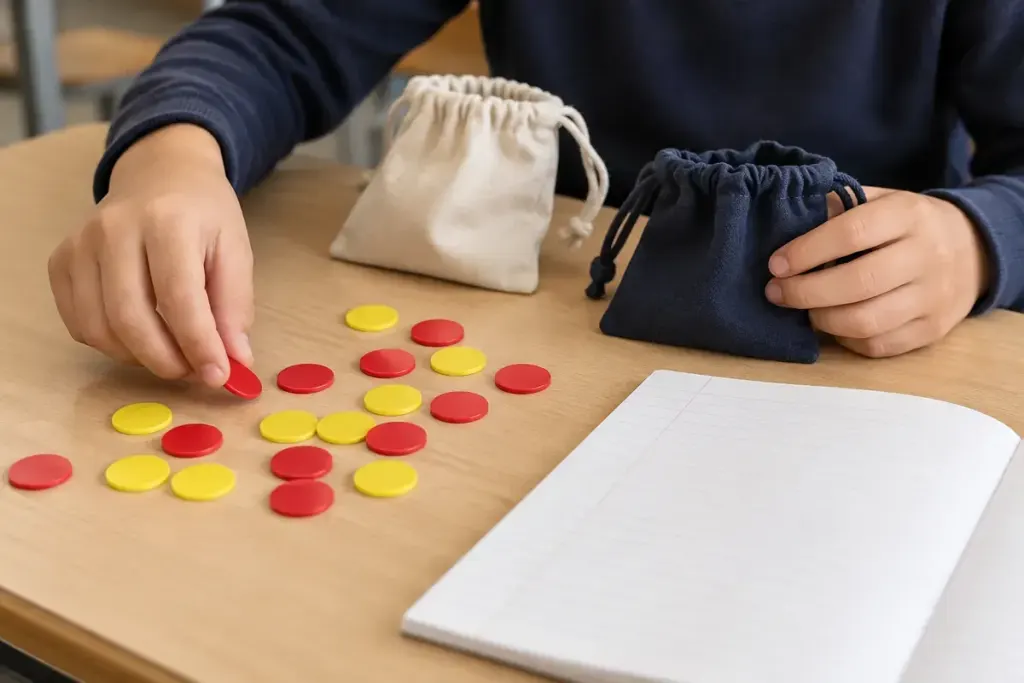
A bag contains two red counters and one blue counter. You draw one counter, keep it out, then draw another. What is the chance of drawing two red counters? The first fraction is easy to spot; the second is where a probability tree earns its place.
Write what remains on each branch
For the first draw, the probability of red is 2/3 and blue is 1/3. After a red counter is removed, one red and one blue remain. Along that branch, the chance of a second red is therefore 1/2. Multiply along the red-then-red path: 2/3 × 1/2 = 1/3.
If the first counter is blue, both remaining counters are red. The chance of red on that second branch is 1. It would be a mistake to copy 2/3 onto every second-stage branch simply because that was the starting fraction.
Check the complete picture
The possible colour paths are red-red, red-blue and blue-red. In this example each has probability 1/3, and their total is 1. Blue-blue is impossible because the bag contains only one blue counter and the first draw is not replaced.
Now change one instruction: put the first counter back before drawing again and mix the bag. The second draw again has two red counters out of three. The probability of red-red becomes 2/3 × 2/3 = 4/9. The arithmetic changed because the experiment changed, not because one diagram was drawn more neatly.
Try the experiment with real counters and record a small number of trials. The observed fraction need not equal the calculated probability exactly. A short run is a useful way to understand the process, not proof that a theoretical fraction must appear after every few attempts.
Before solving the next question, underline the instruction about replacement. Then write what is left at each branch. Those two habits prevent more mistakes than memorising a tree shape without knowing what it represents.