
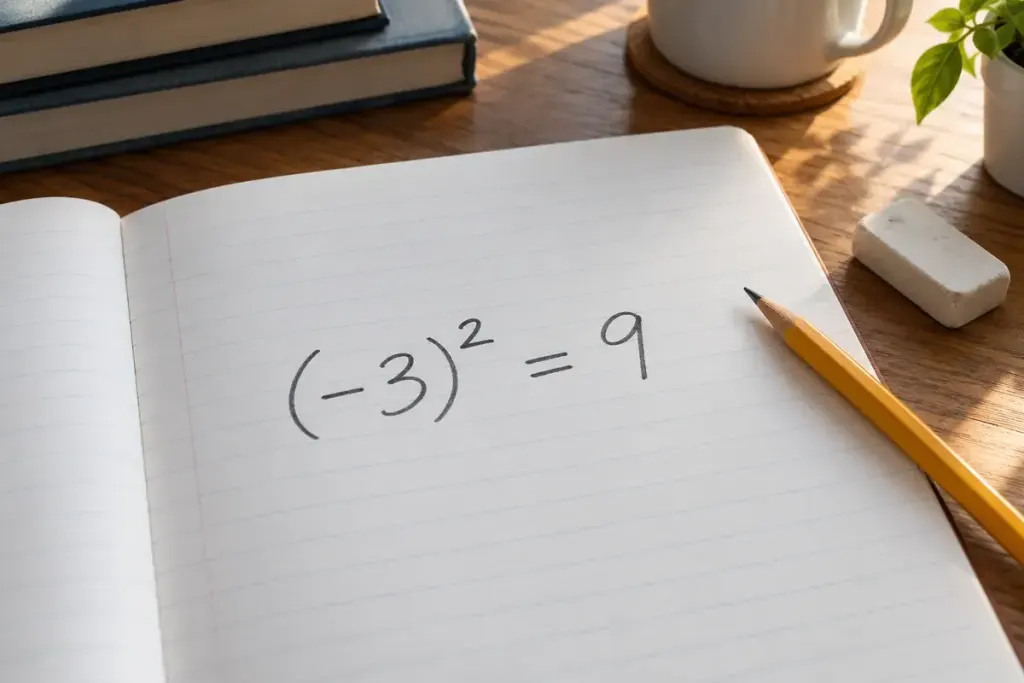
The expressions (−3)² and −3² look nearly identical. Under the usual order of operations, they produce different answers. The brackets tell you what is being squared.
Expand the operation before calculating
In (−3)², the base is the whole number −3. Squaring means multiplying that base by itself: (−3) × (−3) = 9. Both negative factors belong inside the multiplication.
In −3², the exponent applies to 3 before the leading minus is applied. Write it as −(3 × 3) = −9. The minus sign remains outside the square.
| Expression | Expanded form | Result |
|---|---|---|
| (−4)² | (−4) × (−4) | 16 |
| −4² | −(4 × 4) | −16 |
| (−4)³ | (−4) × (−4) × (−4) | −64 |
The third row is a useful check against the overgeneralisation that every power makes a negative number positive. The number of negative factors matters.
Test the notation, not your memory of a button
Calculators and software can use different input conventions. Enter brackets explicitly when you intend a negative base, and inspect how the expression is displayed. A calculator’s unary-minus button and subtraction operator may not behave identically in every interface.
For an original practice exercise, calculate (−2)², −(2²) and (−2)³ by expanding each one. Then check the results: 4, −4 and −8. If your device disagrees, investigate the entry before changing the arithmetic.
When writing by hand, make the brackets and exponent position easy to read. A faint bracket can turn a correct method into an ambiguous answer. In algebra, the same distinction appears between (−x)² and −x².
Before doing any multiplication, point to the base and say what the exponent acts on. That small pause is more reliable than memorising that a minus sign somehow disappears whenever a square appears nearby.