
Zero divided by five and five divided by zero use the same two numbers, but they ask different questions. Writing both as multiplication questions helps a learner see why swapping the order changes everything.
Begin with an empty collection
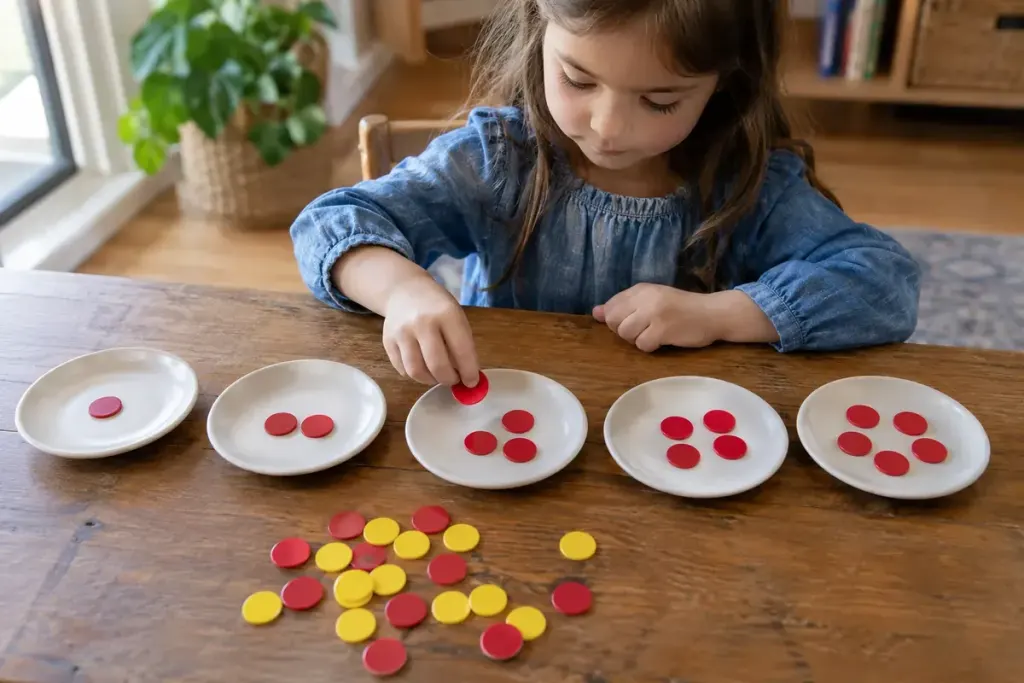
Imagine five bowls and no counters. Share the counters equally between the bowls: each bowl receives zero. In symbols, 0 ÷ 5 = 0. The check is 5 × 0 = 0.
Now ask what number could satisfy 0 × ? = 5. Multiplying zero by any ordinary number gives zero, so there is no number that makes this equation true. That is why 5 ÷ 0 is undefined in ordinary arithmetic.
Give zero divided by zero its own explanation
The multiplication check for 0 ÷ 0 would be 0 × ? = 0. This time every ordinary number fits: zero, one, five and many others all give zero when multiplied by zero. Division is supposed to identify a single answer here, but this question does not select one. So 0 ÷ 0 is also undefined, for a different reason.
It is tempting to say that division by zero equals infinity because dividing by small positive numbers can produce large answers. That observation concerns a changing divisor approaching zero. It does not provide an ordinary numerical answer when the divisor is exactly zero.
Try a three-card sorting task
Write 0 ÷ 4, 4 ÷ 0 and 0 ÷ 0 on separate cards. Ask the learner to write a multiplication check beneath each before deciding whether it has an answer. Let them explain which question has one answer, which has none and which fails to select a unique answer.
If a calculator displays an error, use that as the start of the discussion rather than the explanation itself. The bowls and multiplication checks show the mathematical reason behind the message, and help prevent the mistaken rule that every calculation containing zero must have an answer of zero.