
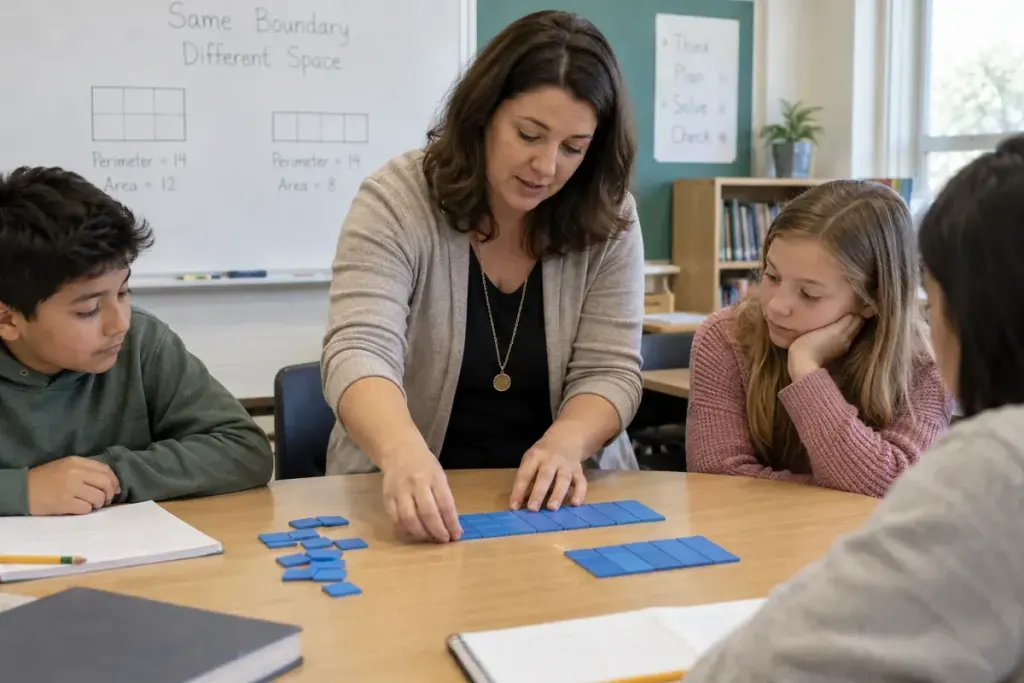
A child can remember the words area and perimeter while still using them interchangeably. Building rectangles with square tiles makes the difference visible: one count follows the outside edge, while the other counts the space covered.
Use equal-sized paper squares or a grid drawn on paper. Explain that each square represents one square unit and each side represents one unit of length. Keeping the units explicit helps prevent two different measurements from becoming just two numbers.
Build two rectangles
Make a rectangle three units long and three units wide. It covers nine square units and has a perimeter of twelve units. Then make one four units long and two units wide. Its area is eight square units, while its perimeter is also twelve units.
Ask the learner to trace each outside edge and then count the squares inside. The shared perimeter does not mean the shapes cover the same amount of space. This is a small counterexample they can verify themselves rather than a rule they must accept from memory.
Let the learner predict a third shape
Try a five-by-one rectangle. Before counting, ask whether its perimeter or area will match either earlier shape. It also has a perimeter of twelve units, but covers five square units. Discuss which part stayed the same and which part changed.
If the learner counts internal tile edges as perimeter, return to tracing only the outside boundary. If they count edge lengths as area, cover the interior with tiles again. These errors reveal which idea needs another concrete example.
Finish with a practical question: would equal lengths of fencing necessarily enclose equal garden space? Let the child explain using the three rectangles. Avoid jumping immediately to a general optimisation formula. A clear explanation of this small example is a useful achievement: the learner can distinguish a boundary from the space it encloses.