
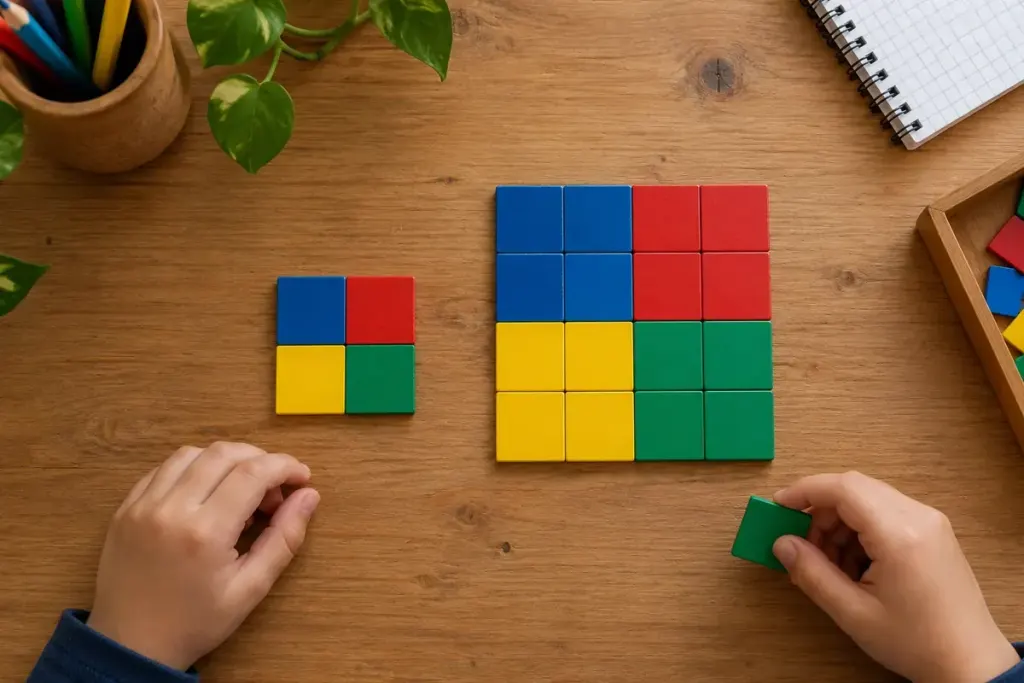
“Twice as big” is an awkward instruction in geometry. It might mean twice the side length or twice the area, and those are different squares. A few paper tiles make the distinction visible.
Build before calculating
Start with a square two tiles wide and two tiles tall. It contains four tiles. Now build a square with each side doubled: four tiles wide and four tiles tall. It contains sixteen tiles.
The side length multiplied by two, but the area multiplied by four. Both dimensions changed. You can divide the larger square into four copies of the smaller one to show where the factor comes from.
Write the relationship
For a square with side length s, the area is s × s. Doubling the side gives 2s × 2s = 4s². Tripling it gives nine times the area. The area scale factor is the square of the length scale factor.
Keep the units visible. A side measured in centimetres leads to area measured in square centimetres. Writing only the number can hide whether the calculation describes a length or a surface.
Try a question that exposes the confusion
Ask: “If I want twice the area, should I double the side?” Use the tiles to explain why the answer is no. Learners who know square roots can explore the exact side multiplier; others can first compare possible squares and estimate.
For a practical connection, imagine enlarging a square piece of paper for a display. Doubling both dimensions needs four times as much paper, before allowing for cutting waste. The example describes geometry, not a prediction of printing costs.
Finish by asking the learner to explain the change without using the formula. “There are twice as many rows and twice as many tiles in each row” shows understanding that a memorised multiplication rule can conceal.