
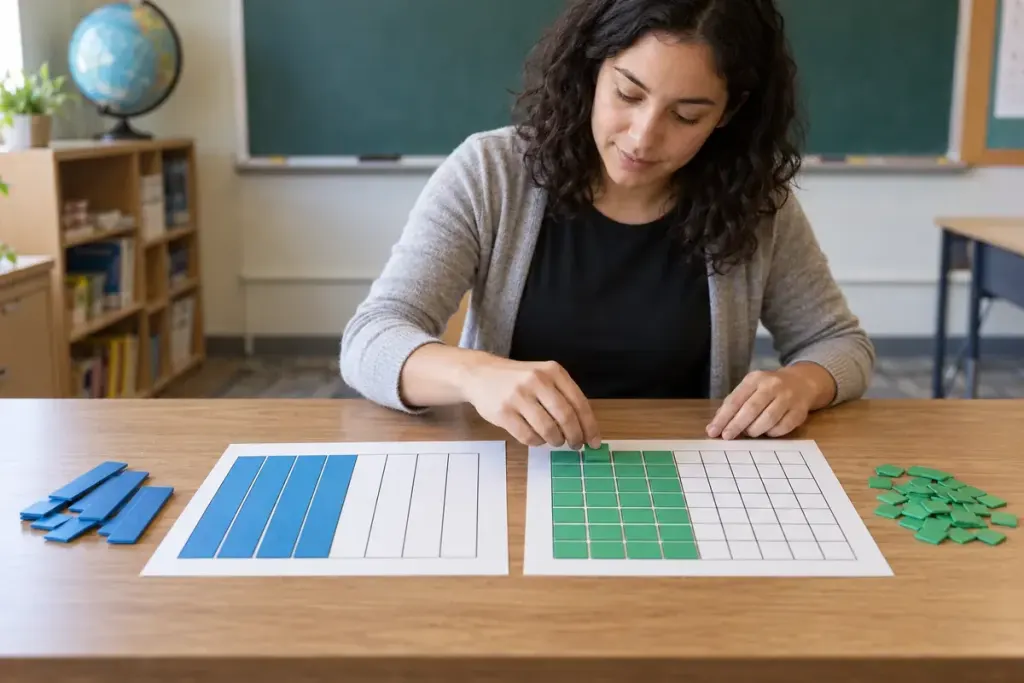
A learner sees 0.5 and 0.50 and chooses the second as larger because it has more digits. That reasoning works for many whole-number comparisons, but decimals need a place-value explanation rather than a digit-counting shortcut.
OpenStax’s introduction to decimals connects decimal notation with fractions and place value. Five tenths and fifty hundredths describe the same amount: 5/10 equals 50/100. The extra zero in this position does not add another part.
Draw the same amount in two ways
Divide one rectangle into ten equal strips and shade five. Divide an identical rectangle into one hundred equal squares and shade fifty. The partition has changed, but the shaded proportion has not. Ask the learner to explain that observation before returning to the written decimals.
Then compare 0.7, 0.70, and 0.07. The first two represent seven tenths; the last represents seven hundredths. This contrast shows why “zeros never matter” would be the wrong lesson. Position matters.
Try an original sorting exercise with cards showing 0.3, 0.30, 0.03, 0.8, and 0.80. Ask for equal-value groups first, then place the groups in order. Encourage explanations using tenths and hundredths rather than “the longer number.”
Keep numerical value separate from measurement precision when that topic arises later. A recorded measurement written with more decimal places may communicate additional precision conventions, even when its mathematical value equals a shorter decimal. That is a different discussion from basic equality.
A useful check is to ask the learner to invent another equal pair and one deliberately unequal pair. Explaining both gives stronger evidence of understanding than copying a row of decimals with zeros added at the end.