
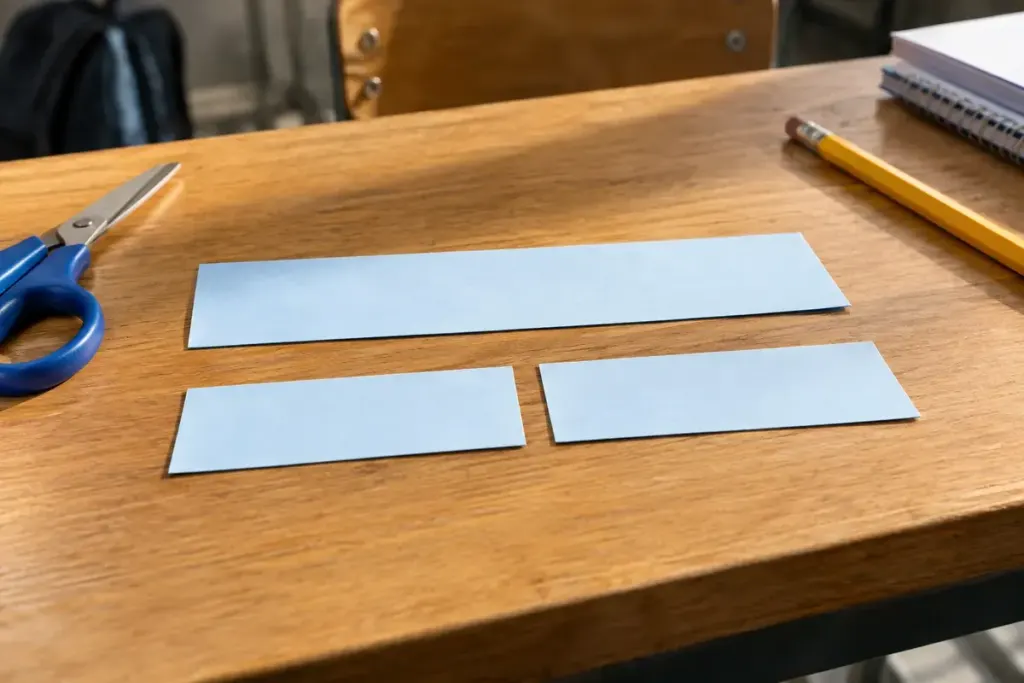
“Division makes numbers smaller” works for some early examples, then fails when a learner meets 3 divided by one half. The calculation is not asking for half of three. It asks how many half-size units fit into three whole units.
Draw three equal strips, each representing one whole. Split every strip into two equal parts. There are six halves altogether, so 3 ÷ 1/2 = 6. The answer is a count of half-units.
Keep the question attached to the picture
Compare two sentences: “What is half of three?” and “How many halves are in three?” The first asks for 3 × 1/2, which is 1 1/2. The second asks for 3 ÷ 1/2, which is 6. The same numbers appear, but the jobs are different.
Now divide the three strips into quarters. Twelve quarter-units fit into three wholes. The smaller measuring unit produces a larger count without increasing the amount of material.
Move from the drawing to the rule
For a nonzero fraction, dividing by it is equivalent to multiplying by its reciprocal. Thus 3 ÷ 2/3 becomes 3 × 3/2 = 9/2. A strip model can show four complete two-thirds groups and another half-group.
Do not teach “flip something” without naming what changes. The divisor is replaced by its reciprocal and division becomes multiplication. The first number is not automatically inverted.
- Check 2 ÷ 1/4 by counting quarters in two wholes.
- Check 2 ÷ 2 by counting groups of two.
- Check 2 ÷ 4 by finding how much of a four-unit group fits.
These examples also show why division does not always make a positive number larger. The divisor matters. Keep the discussion to positive values while building this model, then extend it carefully later. A useful check is to multiply the answer by the divisor and see whether you return to the starting quantity.